Welcome to TGFI - Tourist Guide Federation of India Explore Incredible India with Certified Professional Tour Guides Discover Rajasthan's Rich Heritage, Forts & Palaces Book Trusted & Government Approved Guides Today Serving Jaipur & New Delhi with Expert Tourist Guidance Your Journey, Our Expertise - Travel India with Confidence Welcome to TGFI - Tourist Guide Federation of India Explore Incredible India with Certified Professional Tour Guides Discover Rajasthan's Rich Heritage, Forts & Palaces Book Trusted & Government Approved Guides Today Serving Jaipur & New Delhi with Expert Tourist Guidance Your Journey, Our Expertise - Travel India with Confidence
About Guide

A Tour Guide An Introduction

A tour guide is a person who assist visitors in their chosen language, interpreting and explaining the culture, history, religion, contemporary heritage, social life, current affairs, urban and rural life, political systems, and wildlife during sightseeing tours, whether provided by tour operators/travel agents or individually chosen by tourists. In most countries, a guide must be authorized or licensed by the appropriate authority.

In India, guiding is not a full-time profession but rather a fragmented occupation. Guides are required to obtain a license or identification card from an competent authority to work as guides.

Tour Guide
Categories

Categories of Guides

As per the guidelines framed by the Ministry of Tourism, Government of India in 1996, a three-tier system was introduced and is still in operation:

1

Regional Level Guides IITG (RLG)

Guides in this category, now known as Incredible India Tourist Guides (IITG), are licensed and authorized by the Ministry of Tourism, Government of India, in accordance with the Archaeological Survey of India (ASI) rules. They must be graduate or equivalent and trained according to the Ministry of Tourism guidelines. Originally, their area of operation was limited to a specific region, but after changes in the cadre, they now operate throughout India. IITGs are highly educated, with over 60% of them being postgraduates and most of them speak Foreign languages other then English.

2

State Level Guides

This category of guides is trained, authorized, and licensed by state governments through their respective ministry of tourism. State-level guides must be graduates and are limited to operating within the state for which they are granted a license.

3

Local Level Guides

These guides are trained and licensed by the Ministry of Tourism,s state Government/tour guide of India, for specific municipal areas or districts.

Additional Guide Categories

There are other categories of guides, such as:

A. Monument Guides (ASI)

Guides trained and licensed by the Archaeological Survey of India for historical sites like Fatehpur Sikri, Mamallapuram, Abhaneri stepwell.

B. Monument Guides (Trust)

Many private monuments, temples, mosques, museums, forts, and galleries are run by trusts. These trusts can provide licenses or ID cards to guides trained by them. Only for that particular monument examples include City Palace in Jaipur, Udaipur, Mehrangarh in Jodhpur, Jai Vilas Palace in Gwalior, Jain Mandir in Ranakpur, etc.

C. Forest Nature Guides

Guides trained and authorized by the forest department for specific wildlife sanctuaries.

Regulation

Unauthorized Guides

Despite this extensive network, many unauthorized individuals work as guides, posing challenges to the tourism industry and the legal system. Unauthorized guides may provide inaccurate information, tarnishing the reputation of the country or state. They may also be involved in illegal activities, which can lead to unpleasant incidents. Therefore, unauthorized persons should not be allowed to work as guides, and even authorized guides should be restricted to their designated areas of operation.

Guides
Role of a Tour Guide
Role

The Role of a Tour Guide

A tour guide plays a pivotal role in the tourism industry. They are the eyes and ears of tourists, providing a window to a new world. Tour guides are like teachers to tourists. as they spend a significant amount of time with them. A well-trained guide can make a tour memorable and enjoyable, while an unprofessional guide can negatively impact the experience.

As per the guidelines of the Ministry of Tourism, Government of India, "A guide plays a vital role in bringing satisfaction to tourists visiting a country or region/state. Direct interaction with tourists makes guides responsible for projecting the correct image of the destination, providing accurate information, ensuring the safety and well-being of tourists, and offering a pleasant and satisfying stay during their visits" (Guidelines for RLGs, 2005).
Qualities

Qualities Expected in a Tour Guide

A tour guide is expected to possess the following qualities: well-qualified, knowledgeable, well-groomed, humorous, fair, tolerant, presentable, friendly, helpful, outward-looking, infrastructure-savvy, translator, entertainer, and quick-witted. Additionally, a guide should be a good pathfinder, salesperson, decision-maker, fluent in foreign languages, easily audible, a tour leader, a storyteller, exhibit professionalism, and excel in group organization.

Well-qualifiedKnowledgeableWell-groomedHumorousFairTolerantPresentableFriendlyHelpfulOutward-lookingInfrastructure-savvyTranslatorEntertainerQuick-wittedPathfinderSalespersonDecision-makerFluent in foreign languagesEasily audibleTour leaderStorytellerProfessionalismGroup organization

In Conclusion

In conclusion, the role of a tour guide is pivotal in ensuring a positive and enriching experience for tourists. Guides play a crucial part in promoting the image of a destination and providing accurate information. The guiding profession has its challenges, including seasonal nature, freelance work, long hours, and low payment, but the impact of a well-trained guide on the overall tourist experience is invaluable.

Warm regardsMr. Narendra Singh Rathore
Tour Guide Experience

Responsible Tourism Pledge

For a Guide
  • I Pledge to be a responsible guide
  • I Pledge to respect Tourist ( अतिथि देवो भव:)
  • I Pledge to keep our monuments & Tourist place clean
  • I shall protect our heritage & culture.
  • I shall try my best that tourist take away good memories of our country but don't leave behind other than their footprint.
  • I Shall promote sustainable tourism.
Destination

Jaipur: The Pink City of India

Jaipur, is the capital city of Rajasthan, which is the largest province in India by area. It forms one corner of the famed Golden Triangle of Indian tourism, alongside Delhi and Agra, situated 282 kilometers from Delhi and 225 kilometers from Agra. The city boasts excellent connectivity via air, train, and road, making it a top tourist destination in India.

Positioned at 26.9 degrees north and 75.8 degrees east on the globe, Jaipur is a thriving metropolis with one Municipal Corporation: Jaipur Heritage. It hosts an International Airport and primarily uses Hindi and Rajasthani as its main languages. Its pin code is 3020++, and the area code for landline telephone numbers is +91-141. The population of Jaipur is approximately 5 million, occupying an area of 550 square kilometers.

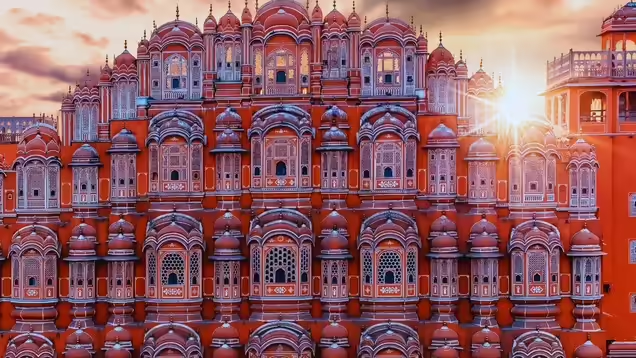
Jaipur - Hawa Mahal

Established in 1727 C.E by Maharaja Jai Singh II of the Kushwaha dynasty, Jaipur traces its lineage to Lord Rama's second son, Kusha. Prior to Jaipur, Amber served as the princely state's capital, located just 9 kilometers north of the city. Maharaja Jai Singh II was not only a great astronomer, astrologer, mathematician, but also a skilled general. He constructed five observatories across India, with the largest one near the City Palace in Jaipur. His knowledge of Indian architecture, particularly "vastu shastra," was extensive. Vidyadhar Bhattacharya, his Prime Minister, and a notable mathematician, astronomer, and astrologer played a crucial role in the city's development.

For about 200 years, under the Mughal Empire, particularly during the reigns of Akbar, Jahangir, Shah Jahan, and Aurangzeb, India experienced political stability and cultural and craft development. The rulers of Amber held significant positions within the Mughal Empire and were considered loyal to the Mughals, which brought them wealth and power in the princely states of Rajputana.

Maharaja Sawai Jai Singh II, born in 1688, ascended to the throne at the age of 11 and ruled for 44 years. After the death of Aurangzeb, he expanded his territory and decided to build a new capital, ultimately selecting a site 9 kilometers south of Amber, near the Mansagar Lake and the Dravyavati River, surrounded by the protective Aravali mountain range. Jaipur's city walls and massive ramparts provide security, featuring seven gates.

The city is divided into nine rectangular residential blocks, known as "chokdi." Two of these blocks are reserved for palaces and government activities, while the rest are allocated to local residents. Jaipur's road network consists of 108-feet-wide roads intersecting at 90-degree angles. Main roads were dedicated to businesses and commercial areas, while houses and temples lined the other roads. This layout contributed to the growth of markets, making Jaipur a leading commercial and business city in India.
Why "Pink City"?

Jaipur earned its moniker, the "Pink City of India," due to the reddish color of its ramparts and buildings along the main roads of the old fortified city. This hue is known locally as "hirmich," and is found in nearby mountain areas. The city was painted in this color to welcome the Prince of Wales during the reign of Maharaja Sawai Ram Singh II. Even after India's independence, this tradition was maintained to preserve Jaipur's heritage.

Chhoti Kashi

Known as "Chhoti Kashi," Jaipur ranks second in the number of temples in India, following Varanasi. The city is renowned for its magnificent temples, including Govind Devji, Radha Damodarji, Ramchandraji, Gopinath ji, Kalki ji, Ladliji, and several other Jain and Hindu temples.

Festivals

Jaipur is also celebrated for its vibrant festivals, notably the grand processions of Teej and Gangaur. The city dazzles during Diwali with breathtaking light decorations in the old city. Holi, the Festival of colors, is another cherished tradition in Jaipur's festival celebrations.

Arts & Crafts

Beyond its historical monuments, Jaipur is a hub for art and crafts. The city's markets offer a rich variety of artistic creations. Notably, the gems and jewelry industry in Jaipur is globally renowned for cutting and polishing of precious and semi-precious stones, making it the jewel capital of India. Gold, silver, Kundan jewelry adorned with these gems are exquisite. The Johari Bazar, M.I. Road, and Amber Road host many jewelry showrooms. Jaipur's expertise in this craft is trusted for generations and even has a dedicated industrial area known as Sitapura Gems and Jewelry Industrial Area.

Textiles

Textiles also play a significant role in Jaipur's handicrafts industry. The city is known for its intricate block printing, which originated in Sanganer and Bagru. Tie and dye techniques are popular, used to create colorful dupattas, shawls, and many more.

Carpets & Blue Pottery

Jaipur's carpet industry, particularly in its suburbs and nearby towns, produces beautiful woolen carpets and is a significant export center. This art has been historically supported by the rulers of Amber and Jaipur. One cannot overlook the art of Blue Pottery in Jaipur. Introduced by the Mughals in the 16th century, it is an intricate ceramic art originating from Uzbekistan. This blue ceramic pottery finds use in decorating mosques, madrasas, forts, and palaces in Samarkand and Bukhara. It remains an integral part of Jaipur's artistic heritage.

In essence, Jaipur stands as a vibrant and culturally rich city with a tapestry of history, art, craft, and festivities that continue to captivate visitors from around the world.

Monuments

Must-Visit Monuments of India

Jantar Mantar

Jantar Mantar

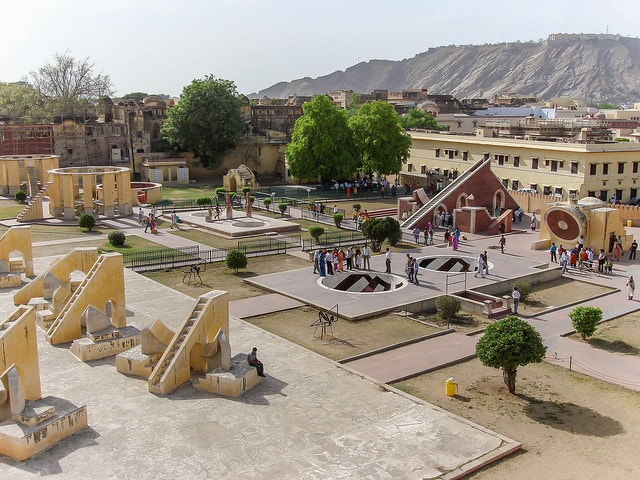
The Jantar Mantar, Jaipur is a collection of 19 astronomical instruments built by the Sawai Jai Singh II, the founder of Jaipur. It was started in 1728 and completed in 1734. It has the world's largest stone sundial. This is a UNESCO World Heritage Site. It is near City Palace and Hawa Mahal. The instruments allow the observation of astronomical positions of celestial bodies with the naked eye.

The monument features instruments operating in each of the three main classical celestial coordinate systems: the horizon-zenith local system, the equatorial system, and the ecliptic system. The Kanmala Yantraprakara is one that works in two systems and allows transformation of the coordinates directly from one system to the other.

Amber Palace

Amber Palace

Amber Palace is located 11 kilometers (6.8 mi) from Jaipur. It is located high on a hill and a principal tourist attraction in Jaipur. Amer Palace is known for its artistic style elements. With its large ramparts and series of gates and cobbled paths, the fort overlooks Maota Lake, which was the main source of water for the Amber Palace.

Amber Palace is great example of Rajput architecture. Some of its buildings and work have influence of Mughal architecture. It is constructed of red sandstone and marble, the attractive, opulent palace is laid out on four levels, each with a courtyard. It consists of the Diwan-e-Aam, or "Hall of Public Audience", the Diwan-e-Khas, or "Hall of Private Audience", the Sheesh Mahal (mirror palace), or Jai Mandir, and the Sukh Niwas where a cool climate is artificially created by winds that blow over a water cascade within the palace. Hence, the Amer Fort is also popularly known as the Amber Palace. The palace was the residence of the Kushwaha rulers. At the entrance of palace near the Singh Pol, there is a temple dedicated of Godess Kali known as Shila Devi which was brought by Raja Man Singh I form Jessore, Bengal.

Albert Hall

Albert Hall (Central Museum)

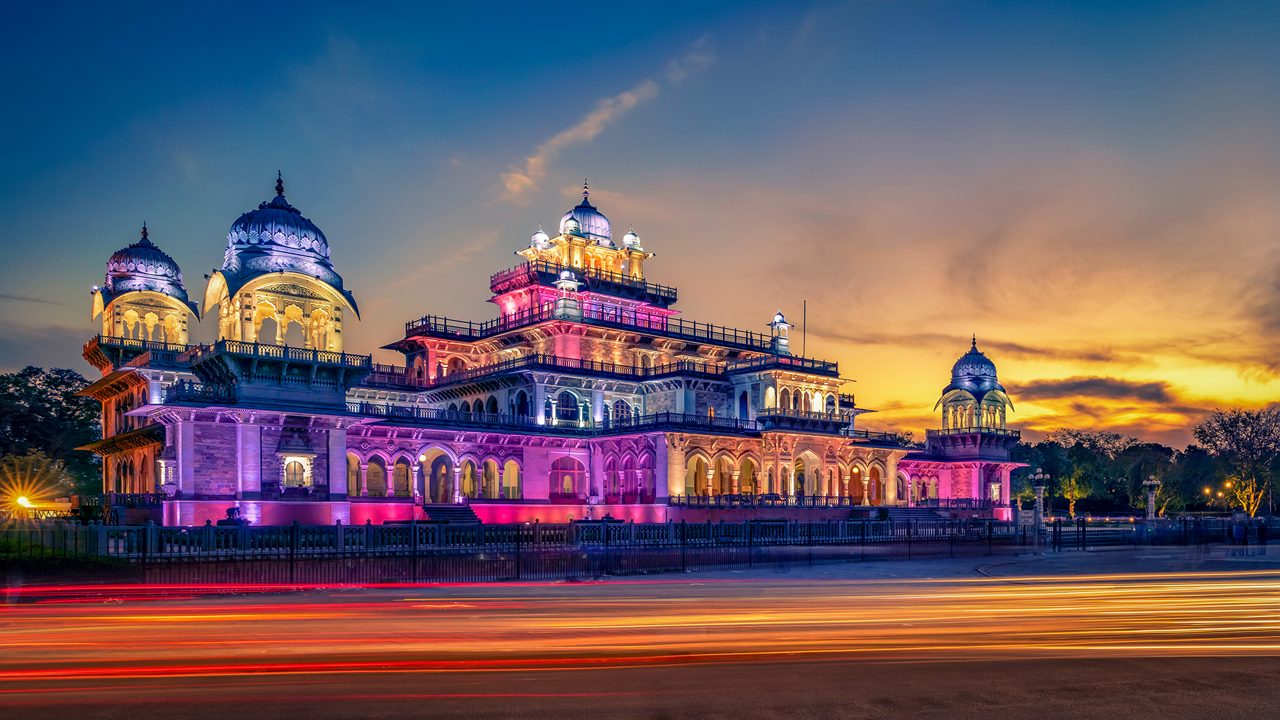
Designed by Sir Samuel Swinton Jacob and assisted by Mir Tujumool Hoosein, this gorgeous façade was opened for visitors as a public museum in 1887. The museum is named after King Albert Edward VII. Foundation stone of the museum laid by hand of prince of Wales on 6 February 1876, Initially, Maharaja Ram Singh wanted to make this museum a town hall but Madho Singh II, his successor, decided to make it a museum as it reflects the art of Jaipur. The museum is the home to an exclusive collection of artefacts that talks about the artwork of different regions of the world. The museum has 16 art galleries to house these unique artefacts. Apart from these, marble art, pottery, ancient coins, carpets, and other such beauties from the bygone era are placed in the museum. It also has the Egyptian Mummy, treating your eyes with the history of the astonishing times. The Indo-Saracenic inspired architecture of Albert Hall, Jaipur, comprising of the huge domes and carved arches that are constructed from sandstone is simply alluring. At night, this majestic façade glows in yellow lights that looks extremely beautiful and mesmerising. You can click pictures with the Albert Hall as the backdrop, relax in the Ram Niwas Garden, explore ancient India's astounding culture, and much more.

City Palace

City Palace

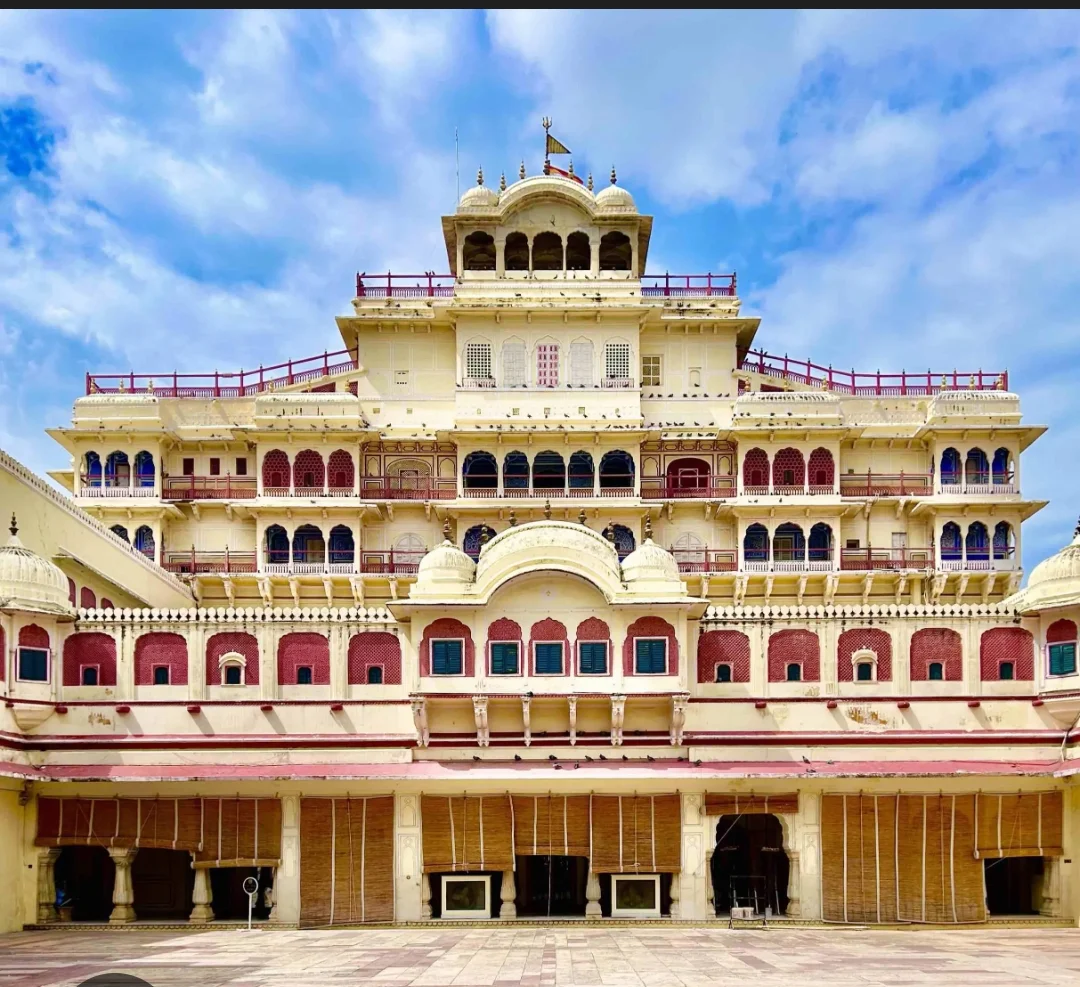
The palace complex lies in the heart of Jaipur city, to the northeast of the very centre, located at 26.9255°N 75.8236°E. The site for the palace was located on the site of a royal hunting lodge on a plain land encircled by a rocky hill range, five miles south of Amber. The history of the city palace is closely linked with the history of Jaipur city and its rulers, starting with Maharaja Sawai Jai Singh II who ruled from 1699 to 1744. He is credited with initiating construction of the city complex by building the outer wall of the complex spreading over many acres. Initially, he ruled from his capital at Amber, which lies at a distance of 11 kilometers (6.8 mi) from Jaipur. He shifted his capital from Amber to Jaipur in 1727 because of an increase in population and increasing water shortage. He planned Jaipur city in nine blocks separated by broad avenues, on the classical basis of principals of Vastushastra and another similar classical treatise under the architectural guidance of Vidyadhar Bhattacharya, a Bengali architect from Naihati of present-day West Bengal The City Palace is in the central-northeast part of the Jaipur city, which is laid in a unique pattern with wide avenues. It is a unique and special complex of several courtyards, buildings, pavilions, gardens, and temples. The most prominent and most visited structures in the complex are the Chandra Mahal, Mubarak Mahal, Shri Govind Dev Temple, and the City Palace Museum.